
The False Legal Grey Area Around Small-Scale Water Reuse
Four different answers. No solution. And a stalled project.
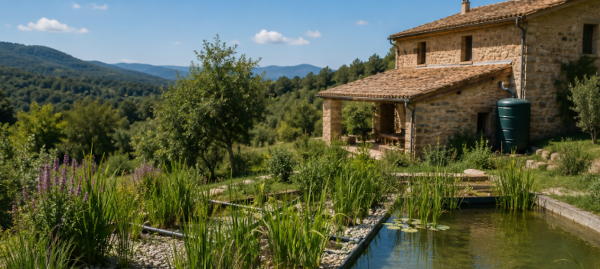
A few months ago, I spoke with the owner of a rural farmhouse in the countryside. Private well water, no connection to mains sewerage, an ageing septic tank. He had been considering water reuse for irrigation for quite some time and, if things worked out, harvesting rainwater and building a natural swimming pond for a small rural accommodation business.
He had already spoken with several people. One consultant told him there was a legal grey area and that he could more or less do what he wanted. The local council said it was not really their responsibility. The Environment Agency never gave him a clear answer. An installer offered him a reed bed treatment system “that solves everything”.
Four different answers. No solution.
This is not unusual. It is the norm.
The problem is not the absence of regulation
In the UK, there are regulations covering treated wastewater reuse, discharges, groundwater protection, swimming facilities and tourism-related installations. Some come from retained European frameworks, others from national environmental and public health legislation.
The problem is that none of those rules were written with an isolated rural property, a private borehole and a small independent project in mind.
They were written for larger systems. For municipal operators. For utilities and regulated infrastructure with technical managers, routine sampling programmes and maintenance budgets. When you try to apply that framework at small scale, the pieces stop fitting together. Not because pieces are missing. But because the puzzle was designed at a different scale.
That creates a space where every authority interprets the issue from within its own remit, no one feels fully responsible, and the property owner receives contradictory answers from people who, technically speaking, are not necessarily wrong. They are simply responding from different regulatory perspectives.
And then someone says: “there’s a legal grey area”
And someone else hears: if it’s unclear, I can do whatever I want.
That is probably the most expensive mistake people make in projects like these.
A legal grey area is not permission. It is the exact opposite. It is the place where what you decide to build and how you justify it matter most. Because if something goes wrong — an inspection, a public health issue, a complaint — there is no perfectly defined framework protecting you. All you really have is what you built and the decisions you made.
Regulatory responsibility does not disappear when the framework becomes unclear. It increases.
What can be done — and what cannot
Some things are entirely feasible. Reusing treated water for irrigation on private land, under appropriate quality and monitoring conditions, can fit within existing regulatory frameworks, even if it requires genuine operational management.
Other things are more complicated. A natural swimming pond open to paying guests becomes a collective-use facility. That activates public health regulation, water quality monitoring protocols and legal liabilities. It is not impossible, but it is not the same thing as a private pond. And treating it as if it were is where problems begin.
And there are ideas that simply cannot work in the way people imagine. Not because the technology fails. But because the intended use has no viable regulatory pathway within that specific context. The technology itself may function perfectly while the project remains legally or operationally unworkable.
Flexibility as an advantage — not an excuse
Collective and highly regulated systems have a necessary rigidity. They are designed to manage risk at scale, using protocols written for generalised situations. That rigidity protects people, but it also limits adaptation. It leaves little room for fine-tuned design or experimentation.
A small private project, by contrast, has far more flexibility. And properly understood, that flexibility is a genuine advantage. It allows systems to be designed more intelligently, adapted to the specific use case, and developed in ways that heavily standardised frameworks would never permit.
But flexibility only becomes an advantage if it is used to design better, not to design less. Regulation always moves more slowly than innovation. Always. That does not mean regulation can be ignored. It means technical responsibility requires staying one step ahead of it.
The problem was never a lack of information
Reed bed treatment or constructed wetlands may well be part of the solution. But they are not the question.
The farmhouse owner had received four answers to four completely different questions. His own question was much simpler and much more practical: what do I actually need the water for, and who will be using it?
That is where the real use case begins. From the use case comes the required water quality. From the required quality comes the system design. And from the system design comes the answer to whether the project is viable, complex, or fundamentally different from what was originally imagined.